

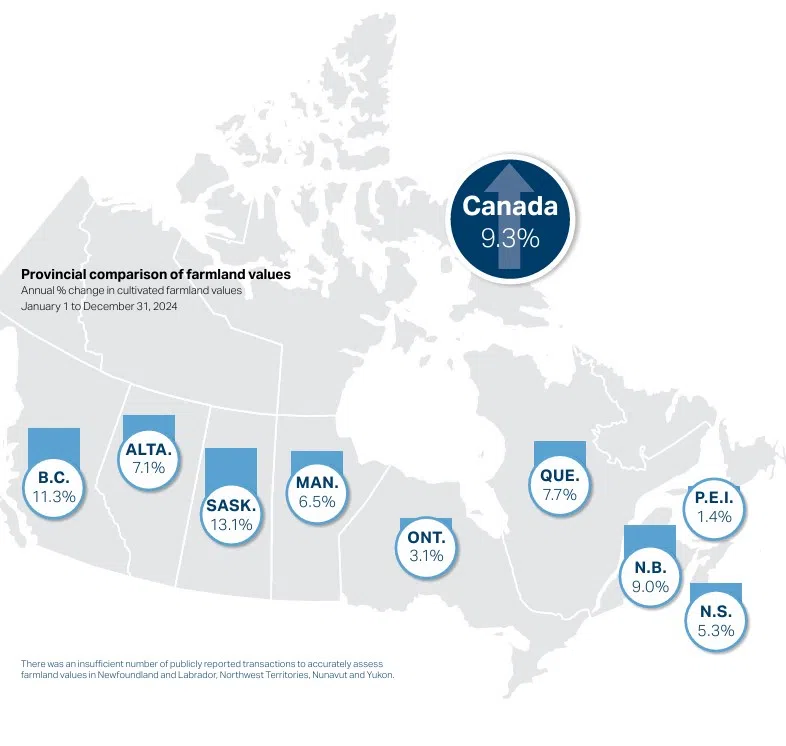
The value of Canadian farmland values in 2024 continued its steady rise, with an average increase of 9.3% nationwide. While this marks a slower pace than 2023, it still surpasses the five-year (8.6%) and ten-year (9.1%) averages. Various factors, including land demand, interest rates, and agricultural profitability, have contributed to these shifts. Below, we break down key trends and influencing factors.
Provincial Trends in Canadian Farmland Values 2024
Between January 1 and December 31, 2024, the highest increase in occurred in Saskatchewan, up by 13.1%, followed by British Columbia (11.3%) and New Brunswick (9.0%). Other provinces experienced growth below the national average.
It is essential to note that Saskatchewan, home to the largest cultivated farmland area, significantly impacts the national average. Alberta and Manitoba are the second and third largest contributors, respectively.
Key Factors Affecting Farmland Values in 2024
Several factors influence the continued increase in farmland values in 2024:
Farm Profitability: Higher net margins in agriculture often lead to greater willingness to purchase land. The 2018-2020 period saw the smallest increases in farmland values, coinciding with lower farm profitability.
Interest Rates: The Bank of Canada began cutting rates in June 2024, reducing borrowing costs. However, rates remain relatively high compared to previous years, impacting purchasing decisions.
Supply and Demand: A limited supply of farmland and ongoing demand from investors and farming operations contributed to rising values.
Irrigated and Pastureland Values
Irrigated land values in Western Canada increased across all regions. In 2024, Saskatchewan led with a 25.8% increase, followed by Alberta (8.6%) and British Columbia (4.4%). Irrigated land remains in high demand, particularly in drier Prairie regions, where projects like the Westside Irrigation Rehabilitation Project aim to support water access for agriculture.
Pastureland values, however, grew at a slower rate than in 2023. British Columbia saw a modest 1.1% increase, while Alberta recorded a 4.6% rise. Manitoba and Saskatchewan posted 8.6% and 8.9% growth, respectively. While cattle receipts increased by 11.4% in 2024, this was lower than previous years, affecting profitability in the sector and moderating land value growth.
Looking Ahead to 2025: What’s Next for Farmland Values?
The outlook for 2025 remains uncertain, with potential trade disruptions at the U.S.-Canada border posing risks for agricultural operations. Additionally, farmland values in 2024 have reached record highs relative to farm income, making future purchasing decisions more cautious.
Despite these challenges, technological advancements, economies of scale, and operational efficiencies continue to drive long-term growth in the agricultural sector. Farmers and investors alike should stay informed and prepared for evolving market conditions.
 The data relating to real estate on this website comes in part from the MLS® Reciprocity program of either the Greater Vancouver REALTORS® (GVR), the Fraser Valley Real Estate Board (FVREB) or the Chilliwack and District Real Estate Board (CADREB). Real estate listings held by participating real estate firms are marked with the MLS® logo and detailed information about the listing includes the name of the listing agent. This representation is based in whole or part on data generated by either the GVR, the FVREB or the CADREB which assumes no responsibility for its accuracy. The materials contained on this page may not be reproduced without the express written consent of either the GVR, the FVREB or the CADREB.